1989

October 27, 2014

1989 is Taylor’s fifth studio album, released on October 27, 2014, through Big Machine Records. Named after her birth year, it is a symbolic rebirth of her artistry that leaves her country roots behind in favor of a fully realized pop sound. Created with collaborators including Max Martin, Shellback, and Jack Antonoff, its sleek, synth-driven production reflects the clarity and control Taylor sought in this new chapter, one closely tied to her move to New York City. At the Grammy Awards in 2016, 1989 won “Album of the Year,” while Rolling Stone later included it in its “500 Greatest Albums of All Time.” Widely regarded as a modern pop classic, 1989 is the most awarded pop album in history.
Lyrically, 1989 traces the aftermath of a failed relationship, but its focus lies in what follows. Framed by the sense of possibility that defined Taylor’s early New York days, the songs move through heartbreak toward something more self-assured—capturing moments of longing, reinvention, and confidence with a tone that feels both reflective and newly unburdened.

Background and Announcement

This article is about the album. For the 2023 re-recording, see 1989 (Taylor’s Version).
Up until the release of her fourth studio album, RED, in October 2012, Taylor had been primarily known as a country artist, even though she had achieved mainstream crossover success early in her career. With RED, however, she began experimenting with unapologetic pop sounds, stretching beyond the country roots that had made her a star. Key figures in this transformation were the Swedish pop producers Max Martin and Shellback, who guided Taylor in adapting her confessional songwriting style to the precision and immediacy of pop hooks. Early tracks like “We Are Never Ever Getting Back Together” and “I Knew You Were Trouble.” became international hits, including her first No. 1 on the Billboard Hot 100, signaling that she was ready to take the risk of leaving country music behind.

The move felt both inevitable and necessary for multiple reasons. Taylor had already achieved everything possible in country music—receiving a lifetime achievement award at the CMA Awards in 2013 at just 23. She also knew the industry was eager to replace her with a younger version of herself. On top of that, tabloid scrutiny over her personal life, including her relationship and breakup with English singer Harry Styles, painted her as “boy-crazy,” exposing her to online hate and real-life slut-shaming. Faced with this, Taylor resolved to embrace the “single life.” And there was no better place to do it than New York City.

Her move to The City That Never Sleeps in March 2014 offered a sense of freedom and new creative possibilities. Immersed in late-80s pop, Taylor drew inspiration from artists such as Annie Lennox, Phil Collins, and Like a Prayer-era Madonna, shaping the sound that would become 1989. When she announced the album and her full embrace of pop on August 18 via a global livestream from the Empire State Building, she explained her fascination with the 1980s and the clarity it brought to her artistic vision:

«I really loved the chances they were taking, how bold it was. It was apparently a time of limitless potential. The idea of you could do what you want, be what you want. The idea of endless possibilities was kind of a theme in the last two years of my life.»

Her record label, however, was not supportive of her decision. Top executives warned her repeatedly that leaving the genre that had launched her career was unwise. Some even suggested adding fiddles to singles like “Shake It Off” so country radio could still play them. But Taylor stood her ground, famously saying, “When you chase two rabbits, you lose them both.” The clarity of that decision would come to define what followed: 1989 cemented her as a defining pop icon of her generation. In abandoning the need to hold onto the past, she stepped into a version of herself that felt fully realized. With 1989, Taylor found herself—and somehow, that was everything.
General Information
ArtistTaylor Swift
Released October 27, 2014
Recorded April 2013–June 2014
Studios Conway (Los Angeles)
Jungle City (New York)
Lamby's House (Brooklyn)
MXM (Stockholm)
Pain In The Art (Nashville)
The Hideaway (London)
Genre Synth Pop
Length 48:41 (Standard Edition)
Label Big Machine Records
Producers Max Martin
Shellback
Jack Antonoff
Nathan Chapman
Imogen Heap
Mattman & Robin
Ali Payami
Ryan Tedder
Noel Zancanella
Taylor Swift
Album Announcement

Title Significance

Taylor named 1989 after her birth year, underscoring the album’s deep ties to 1980s synth-pop. She described the title as a symbolic rebirth—one that redefined her image and artistic direction, while decisively severing ties with the country stylings of her earlier work. The idea came to her in a dream on January 27, 2014, the night after RED lost “Album of the Year” at the Grammy Awards. Reflecting on it later that year, she explained:

«It was the night of the Grammys this year. […] I remember going home and playing a lot of the new music I had recorded for some of my backup singers and one of my best friends. We were all sitting in the kitchen and I was playing them all this music, and they were just saying, ‘You know, this is very eighties. It’s very clear to us that this is so eighties.’ We were just talking and talking about how it’s kind of a rebirth in a new genre, how that’s a big, bold step. Kind of starting a part of your career over. When they left that night, I just had this very clear moment of, ‘It’s gotta be called 1989.’»

1989 Era

In 2014, Taylor relocated to New York City. The 1989 era catapulted her into global superstardom, fully transitioning to pop.

Songs on 1989

Read Taylor’s foreword for 1989 and its re-recording, then dive into the stories behind the album’s songs.

1989 (Taylor's Version)

1989 (Taylor’s Version) is Taylor’s favorite re-record. The original album changed her life in countless ways.
Taylor Swift, Max Martin and Shellback writing "Shake It Off" (TAS Rights Management, 2014)

Writing and Recording

The first song that ended up on 1989 was “This Love,” written as a poem in October 2012 around the release of RED. She brought it to longtime collaborator Nathan Chapman, marking the final time they worked together and closing a chapter of her earlier, country-rooted creative process. Afterward, she paused writing while preparing for “The RED Tour” (2013-2014), using that time to reassess her musical direction.

Taylor ultimately committed to a full pop reinvention, aiming to create a cohesive album rather than a “collection of songs.” During the promotion for 1989, she said she “woke up every single day not wanting, but needing to make a new style of music than I’d ever made before.” To guide that transition, she reunited with Max Martin and Shellback, beginning sessions in April 2013; the duo would go on to produce the majority of the album. Their work drew inspiration from 1980s artists like Peter Gabriel and Annie Lennox, shaping a sound Taylor described as full of “endless possibilities:”

«It [the 1980s] was a very experimental time in pop music. People realized songs didn't have to be this standard drums-guitar-bass-whatever. We can make a song with synths and a drum pad. We can do group vocals the entire song. We can do so many different things. And I think what you saw happening with music was also happening in our culture, where people were just wearing whatever crazy colors they wanted to, because why not? There just seemed to be this energy about endless opportunities, endless possibilities, endless ways you could live your life. And so with this record, I thought, 'There are no rules to this. I don't need to use the same musicians I've used, or the same band, or the same producers, or the same formula. I can make whatever record I want.'»

By November 2013, Taylor told Billboard she was already “six months deep in the songwriting process. There are probably seven or eight songs that I know I want on the record, and that’s really ahead of schedule for me. I’m just stoked because it’s already evolved into a new sound, and that’s all I wanted.”

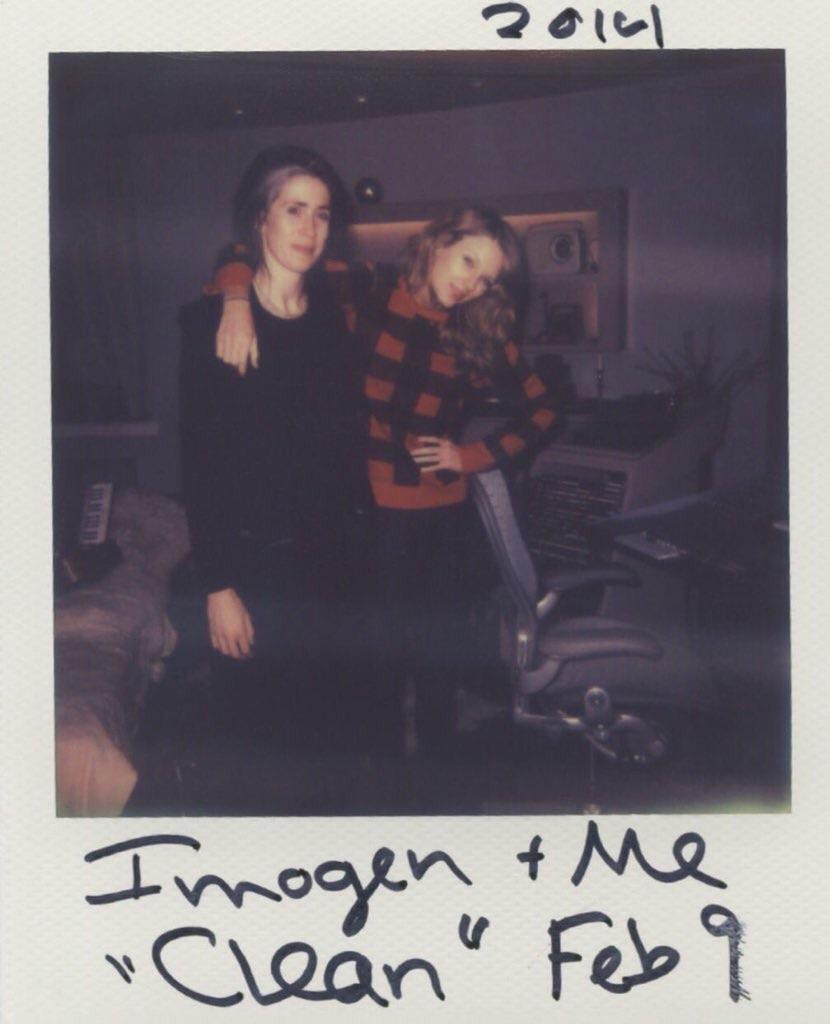
Another key collaborator was Jack Antonoff, whom Taylor had befriended the year prior. After encouraging him to pursue producing, she brought him on board following their first collaboration, the new-wave “Sweeter Than Fiction” (2013). He went on to co-write and co-produce the tracks “I Wish You Would,” “Out of the Woods,” and “You Are In Love,” marking the beginning of a long and influential creative partnership. Taylor also worked with Ryan Tedder on “Welcome to New York” and “I Know Places,” and teamed up with Imogen Heap for “Clean,” which she completed in London in February 2014.

A final burst of writing with Martin and Shellback in Los Angeles that same month produced “Style” and “Shake It Off,” the latter of which made Taylor realize the album was complete. 1989 was ultimately finished following the final leg of “The RED Tour” in June, completing her bold transition into pop.

Making of

Taylor Swift for 1989 (Sarah Barlow & Stephen Schofield, 2014)

Lyrical Themes​

The lyrical themes of 1989 focus on reinvention, self-discovery, and moving on from past heartbreaks, set against the glittering, fast-paced backdrop of New York City. While lost love has been a recurring subject in Taylor’s earlier work, 1989 presents it through a different lens, reflecting her transformation from youthful idealism to a more pragmatic perspective. The album explores the tension between her fairy-tale notions of romance and her growing cynicism, portraying failed relationships with wistfulness and nostalgia rather than vindictiveness. Unlike previous albums, where narrators often appeared as victims of ill-fated romances, here she examines heartbreak with a nuanced awareness of life’s gray areas, suggesting that one can feel content or even grow from a love that didn’t last. She explained her shift in attitude to NPR in 2015:

«In the past, I've written mostly about heartbreak or pain that was caused by someone else and felt by me. On this album, I'm writing about [...] looking back on a relationship and feeling a sense of pride even though it didn't work out, reminiscing on something that ended but you still feel good about it, falling in love with a city, falling in love with a feeling rather than a person. And I think there's actually sort of a realism to my new approach to relationships, which is a little more fatalistic than anything I used to think about them.»

Her disenchantment with the idea of a “happily ever after” is apparent across the songs, as she confronts the realities of love while acknowledging the lessons and personal growth that come from disappointment. A recurring subtheme throughout the album is the media as a detractor in budding romance. In songs like “Blank Space,” “I Know Places,” and “Wildest Dreams,” Taylor grapples with how her public image—especially the perception of her as a serial dater—precedes her, creating an environment in which relationships feel exposed and hunted. The lyrics evoke a desire to hide away from crowds and gossip, capturing the tension between private intimacy and public scrutiny. This sense of vigilance underscores her emotional evolution: she is learning to protect herself and her love from external pressures.

At the same time, Taylor retains her storytelling roots, honed from her country music background, but adapts them for a pop context: the lyrics are more ambiguous, use repeated track titles to create memorable hooks, and are less explicitly biographical, allowing for wider interpretation. According to her, the songs together form a narrative arc; the album’s liner notes contain 13 one-sentence “secret messages” for each track, collectively tracing the emotional journey of a past love—from heartbreak to recovery to self-discovery.

Composition

Overall, the production of 1989 reflects Taylor’s deliberate pivot into pop, blending retro influences with contemporary studio techniques to create a cohesive, forward-looking sound that defined her reinvention as a global pop artist. She applied cohesion through the use of synthesizers, electronic drums, and layered vocals, creating a signature 1989 sound that threads through both the upbeat tracks like “Shake It Off” and the introspective songs like “Clean.”
Taylor repeatedly emphasized in interviews that her primary goal for 1989 was to create a “sonically cohesive” album. She wanted each track to feel like part of a unified sound world, with recurring textures, tones, and moods that would make the album feel intentional from start to finish. During a presentation for Grammy Pro in October 2015, she explained:

«I wanted it to be a sonically cohesive album, and it ended up really being the first I’ve done since Fearless. I also wanted the songs to sound exactly how the emotions felt. I know that’s pretty vague, so I really didn’t know where it was going to go, but I knew that I wanted to work with the collaborators I had such crazy electricity with on RED, like Max Martin. I wanted to do some things that sounded nothing like what we had done before.»

This vision guided her choice of collaborators—Max Martin and Shellback for their precise, hook-driven pop sensibilities, Jack Antonoff for his atmospheric layering, and Ryan Tedder for anthemic, polished energy—ensuring that even with different production styles, the songs felt connected.

Shake It Off

“Shake It Off” is about brushing off criticism and negativity and unapologetically being yourself.

Blank Space

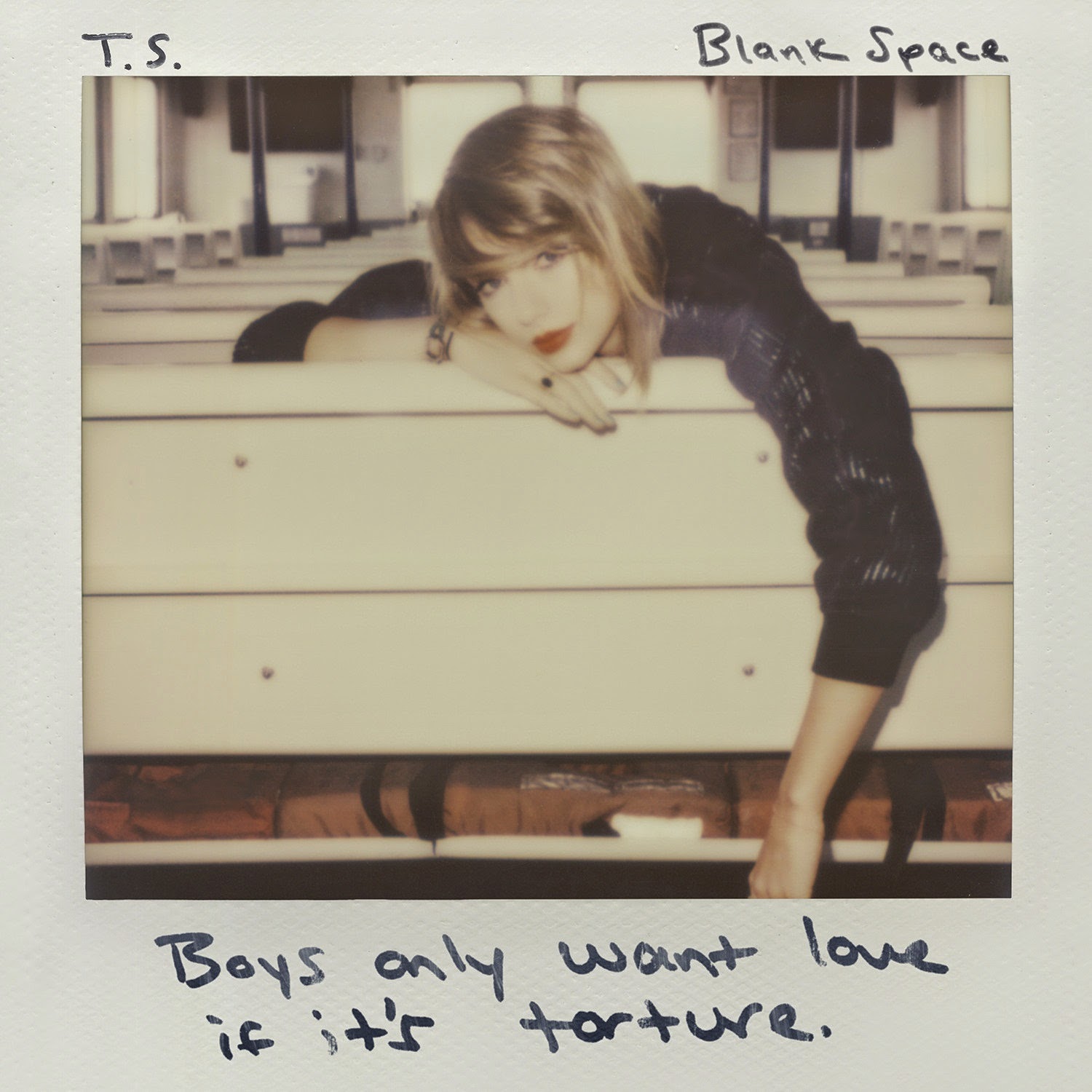
“Blank Space” satirizes Taylor’s media-created reputation as a hopeless “boy-crazy” serial dater.

Style

“Style” reflects an irresistible, cyclical romance that remains magnetic despite its complications and flaws.
Taylor Swift for 1989 (Sarah Barlow & Stephen Schofield, 2014)

Art Direction

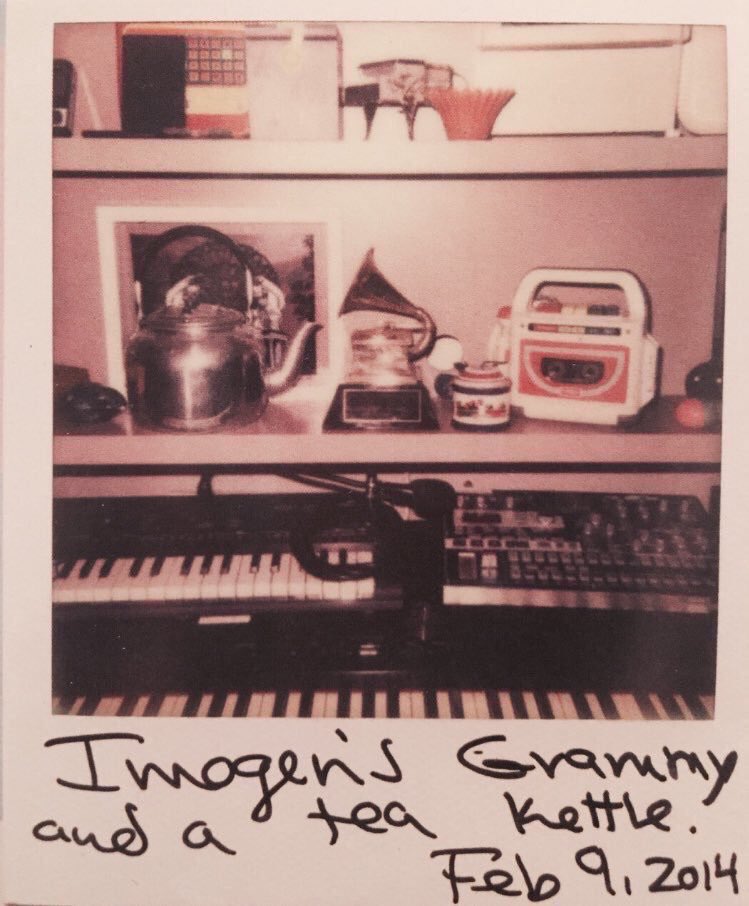
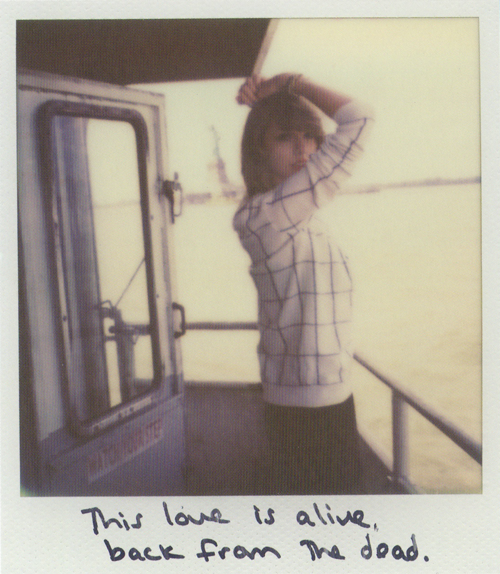
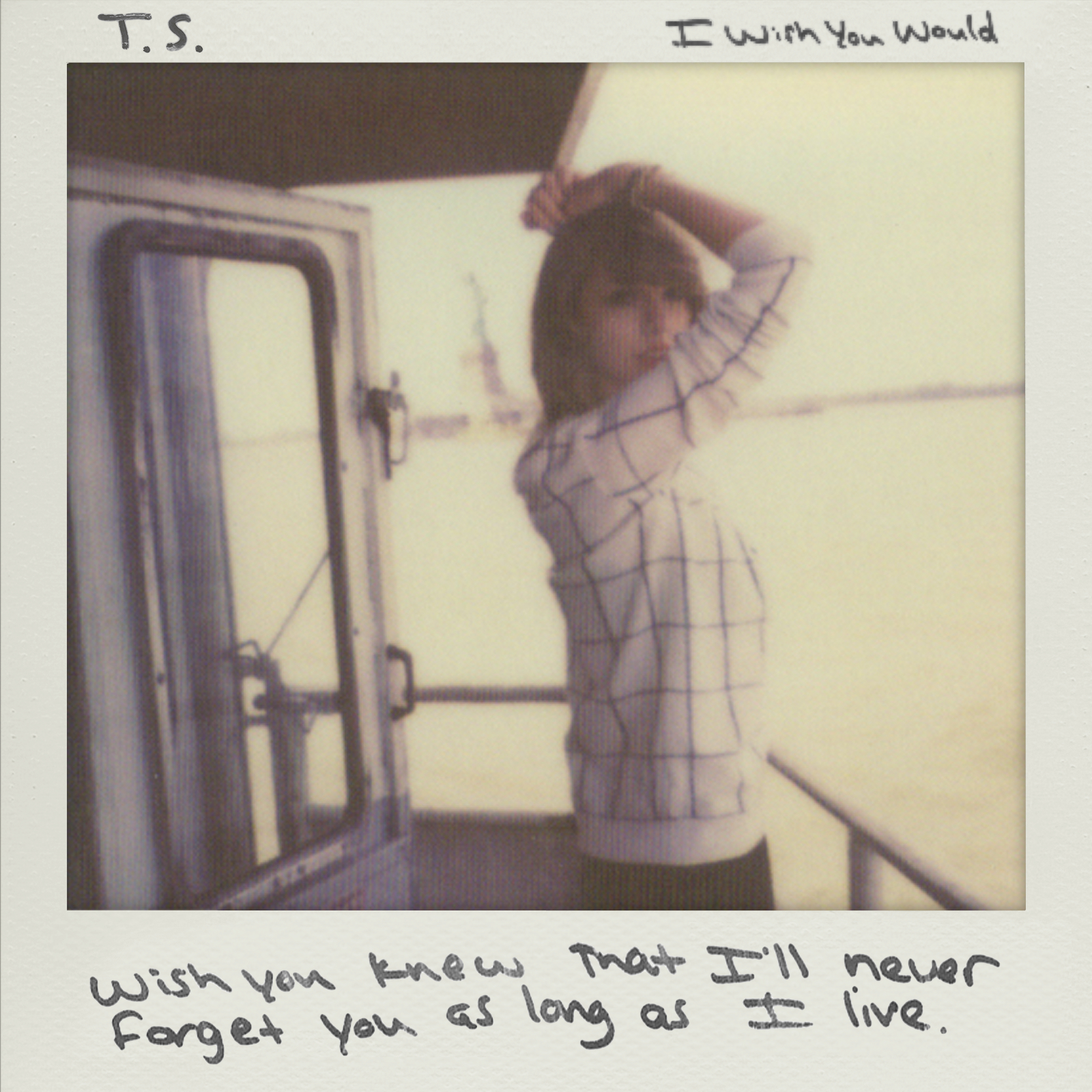
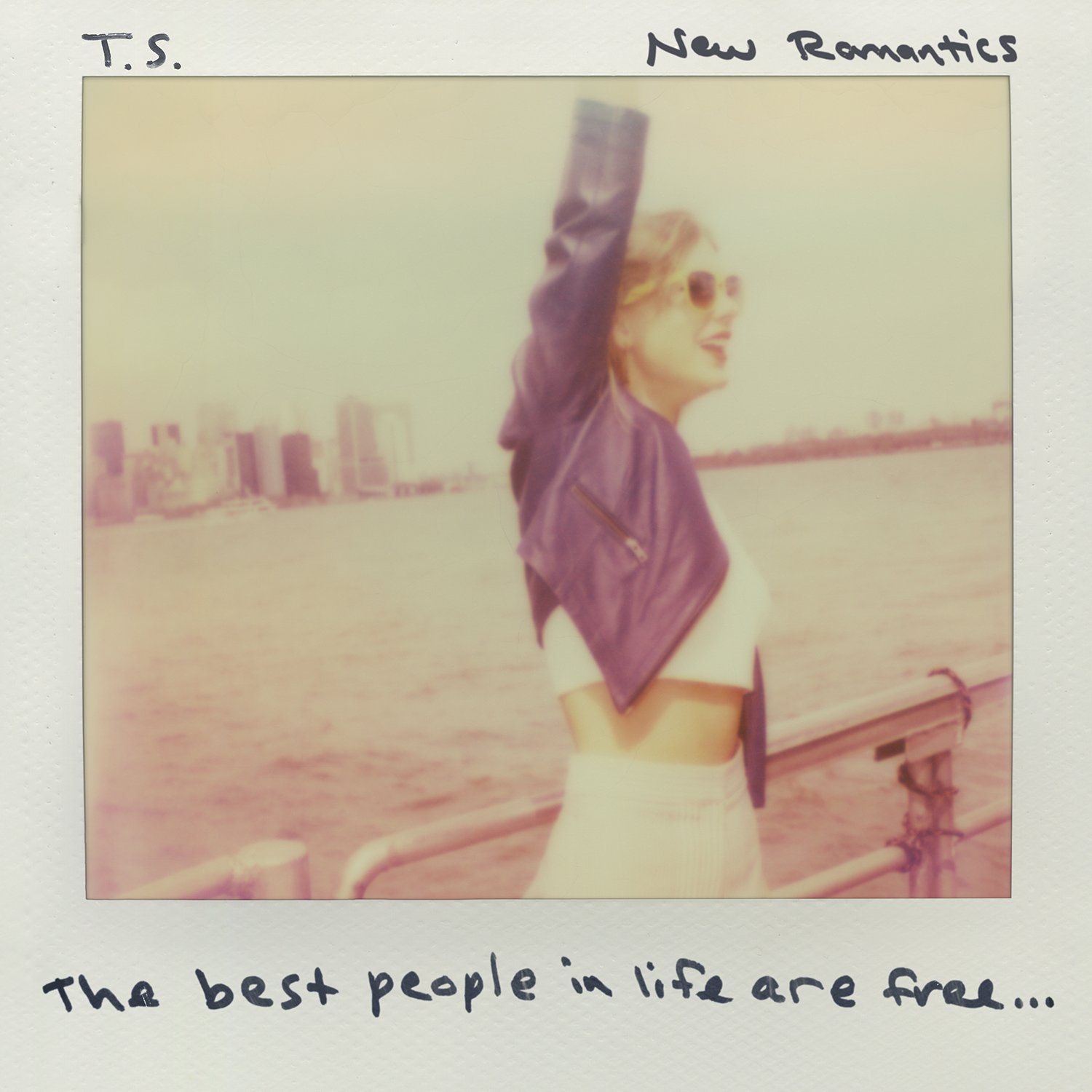
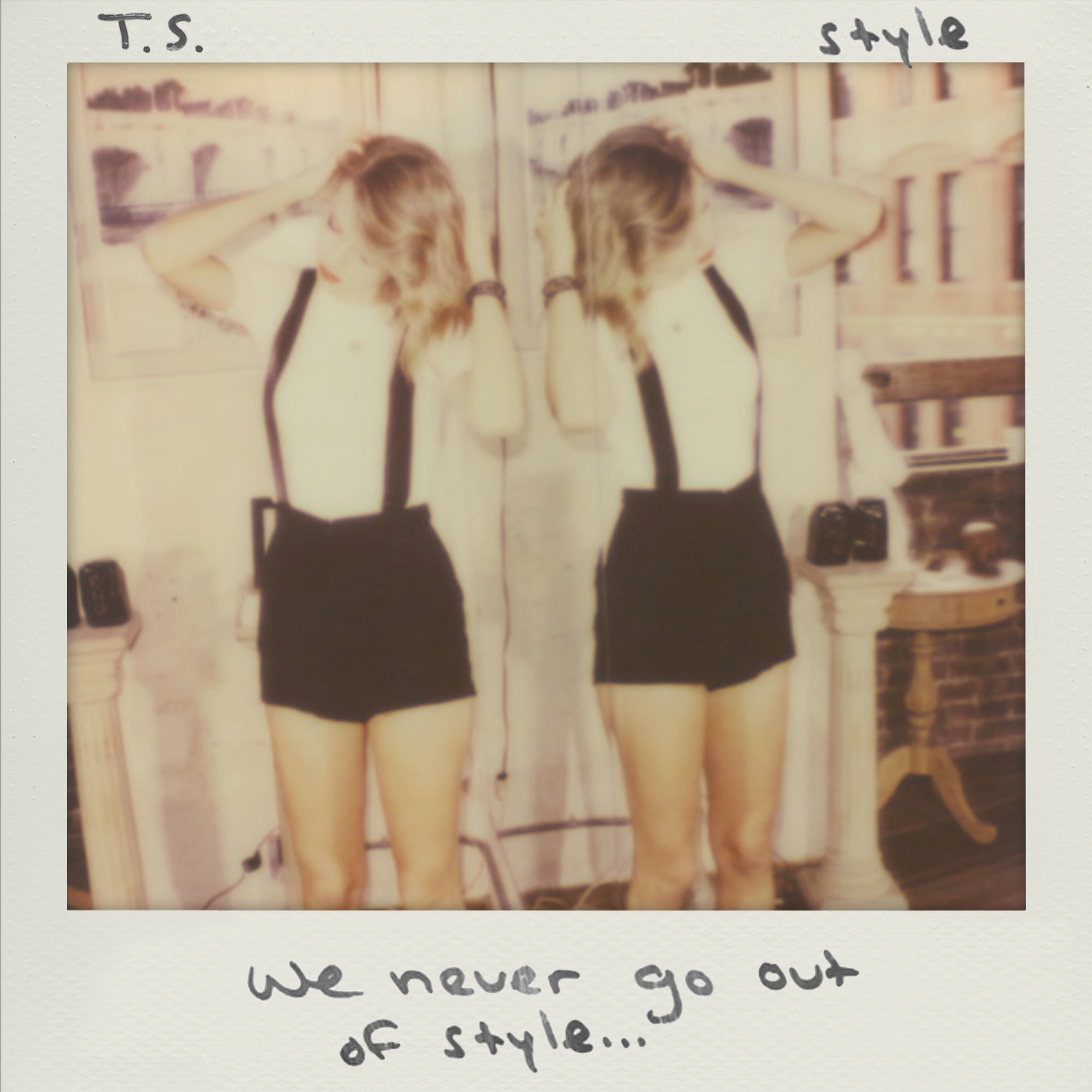
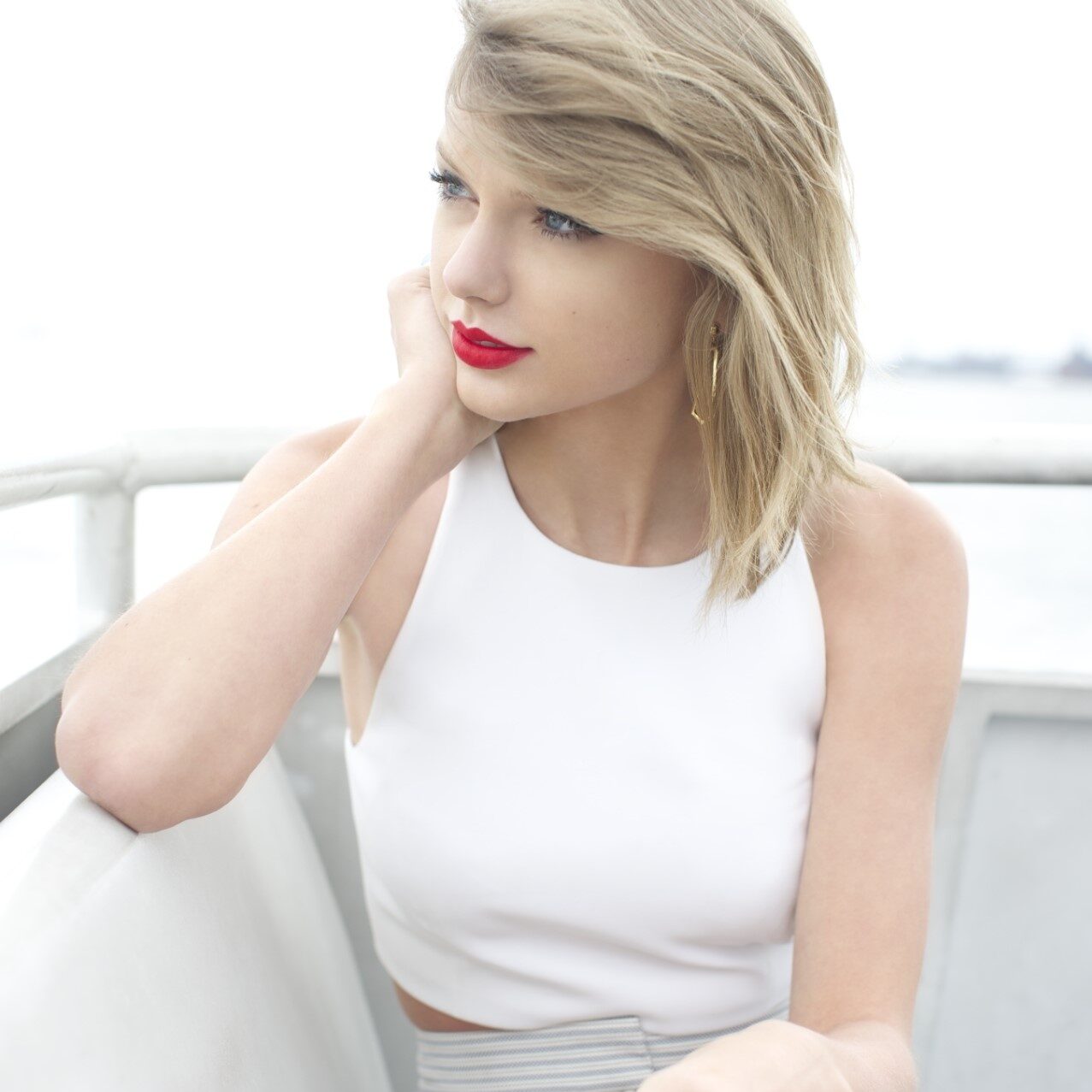
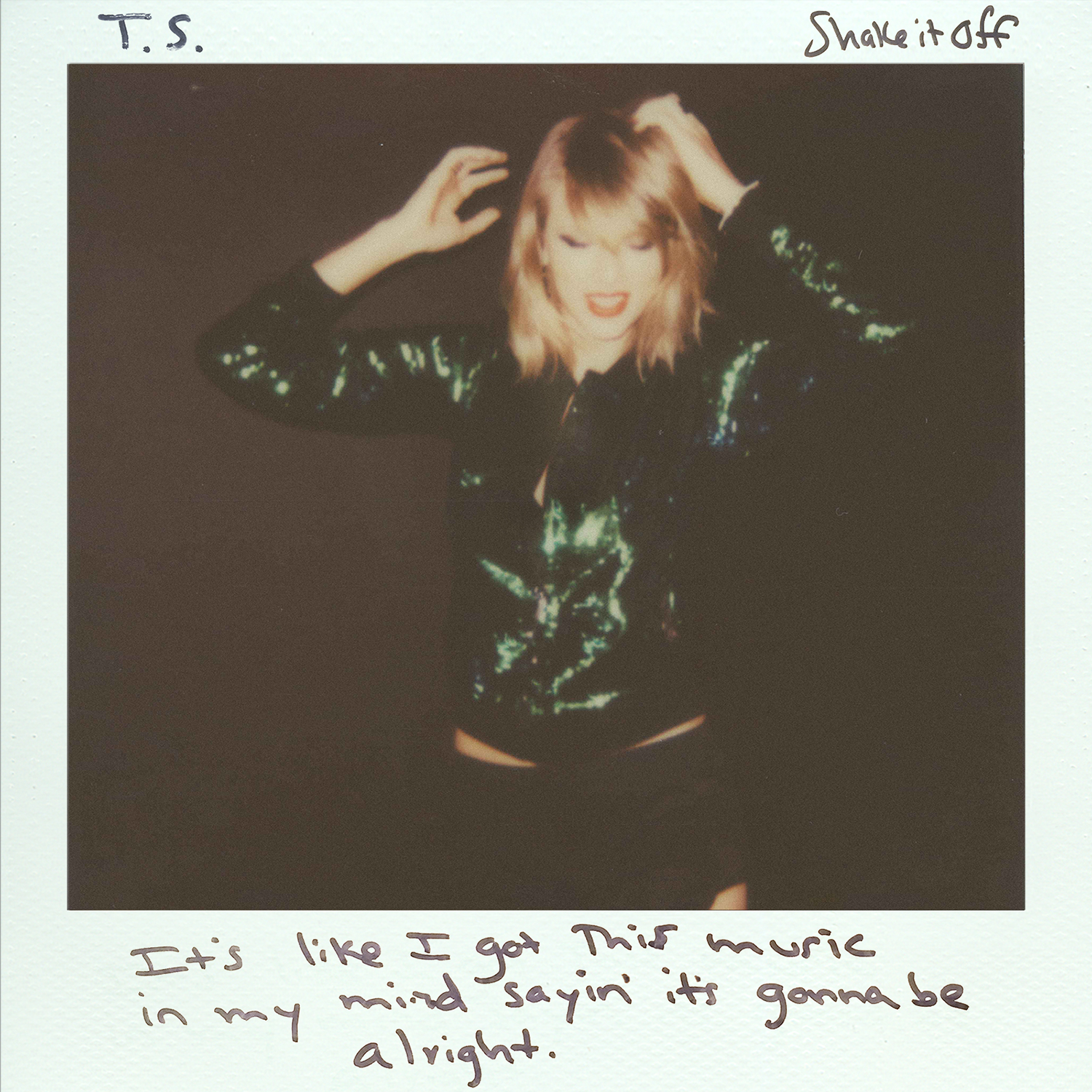
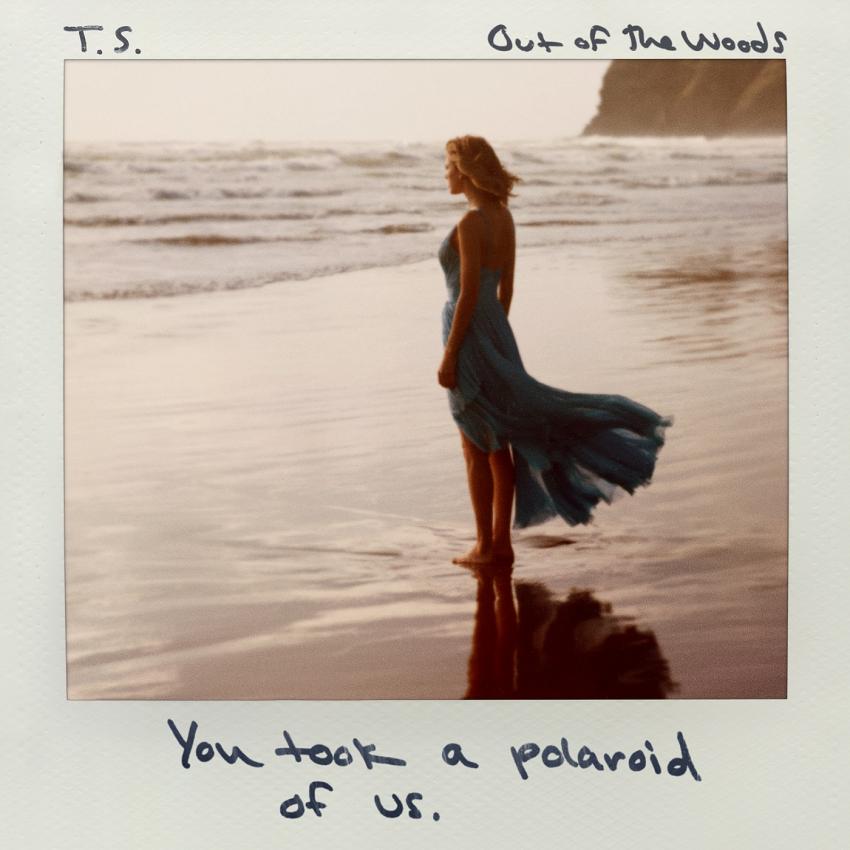
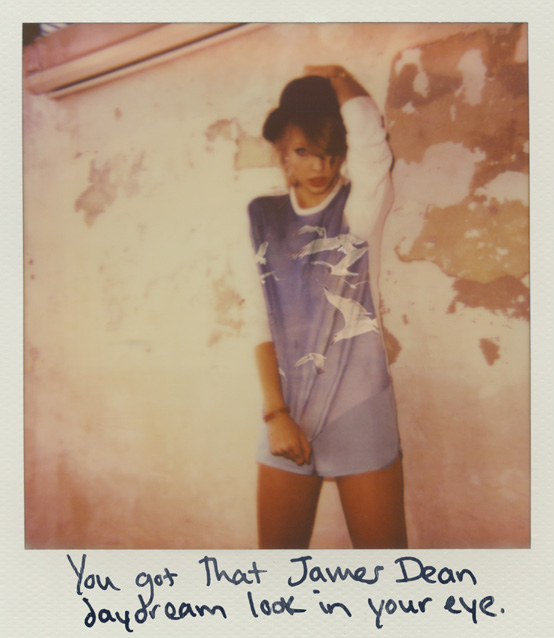
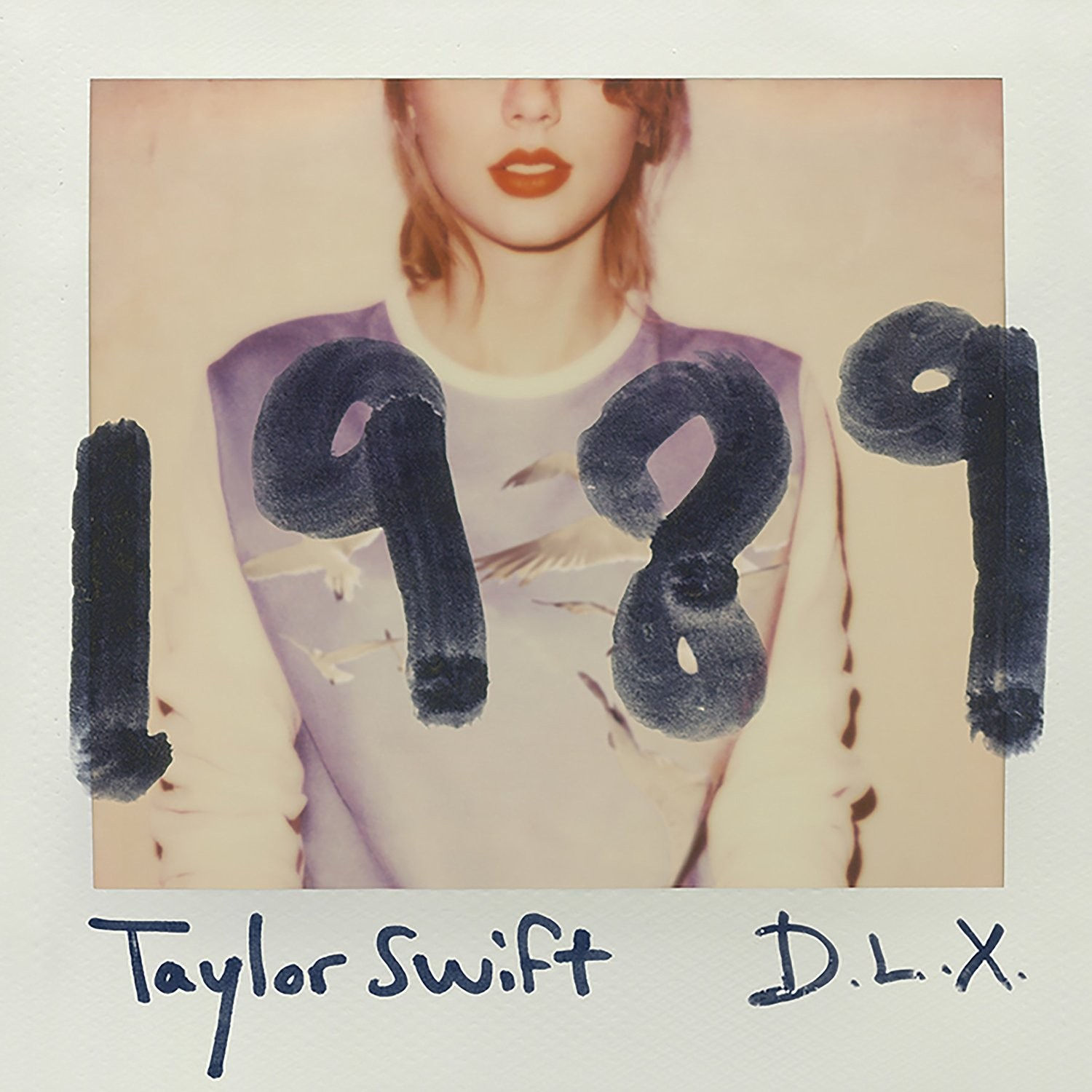
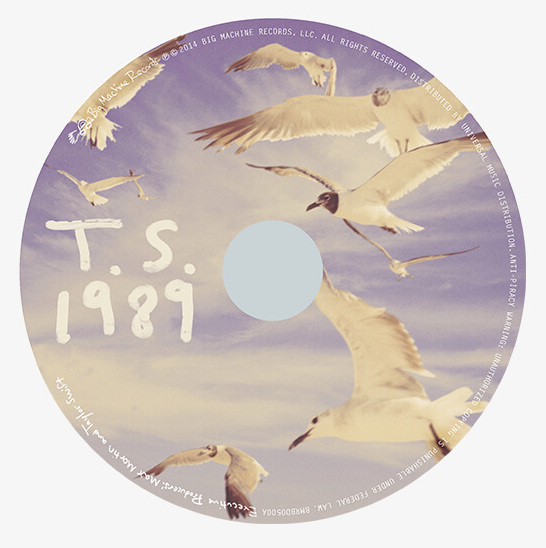
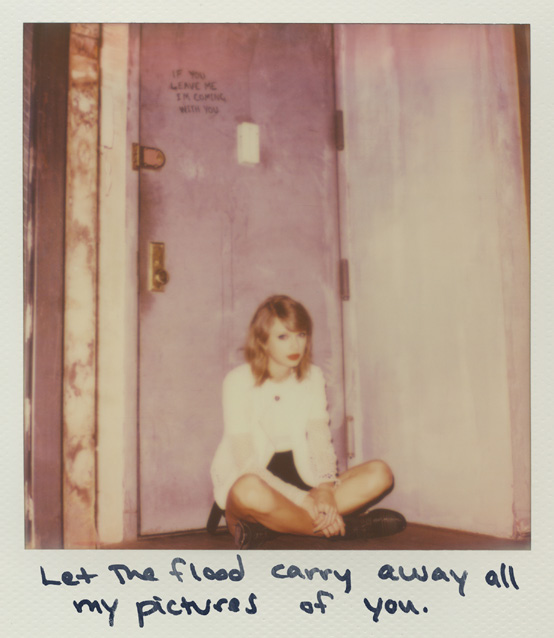
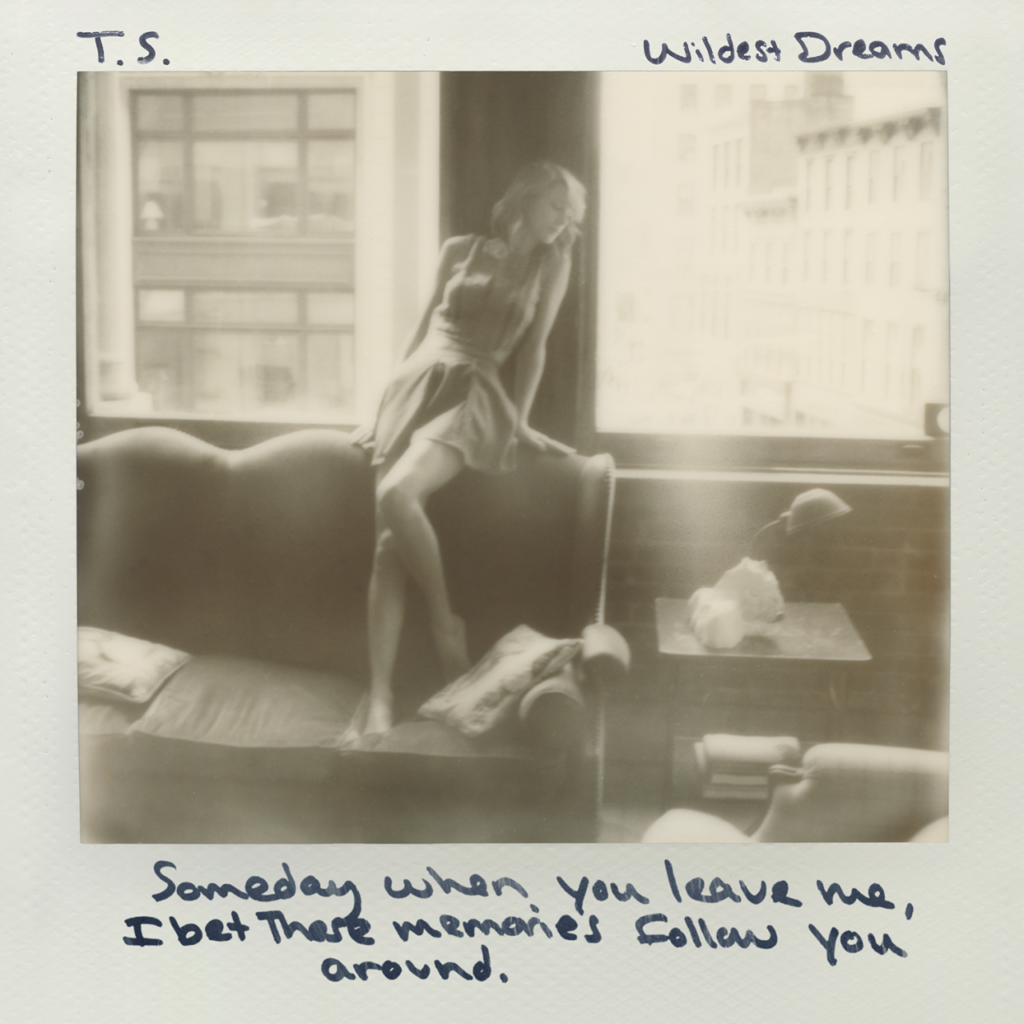
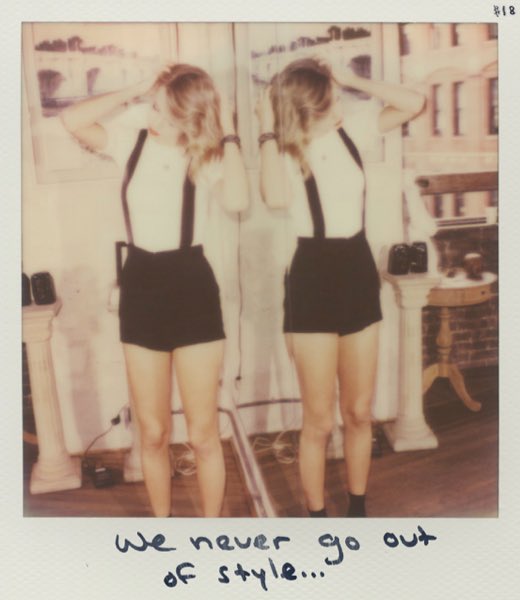
The visuals for 1989 leaned heavily on 1980s-inspired motifs, portraying Taylor in various settings such as New York City backdrops and recording sessions with her producers. The photos are often intentionally out-of-focus or off-framed, with a sepia-tinged treatment, and feature lyrics from the album written in black marker along the bottom. The images combine digital photography and Polaroids, evoking pastel tones and neon accents to create a nostalgic yet modern urban vibe.

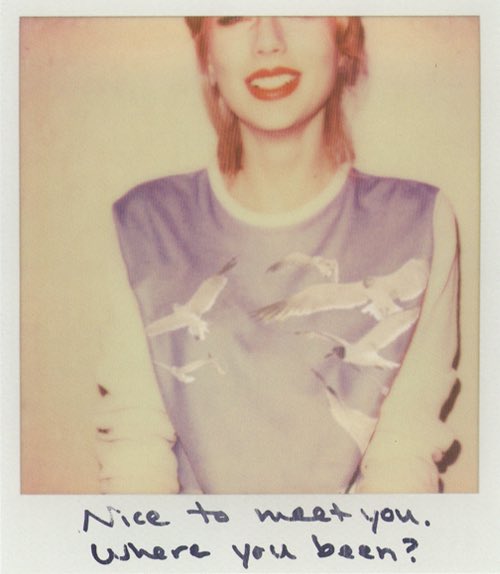
Taylor collaborated with Nashville-based Sarah Barlow and Stephen Schofield, both of whom had independently befriended her before their first paid assignment together shooting the cover of her 2012 album RED. In a Musicbed interview, Barlow revealed that for the 1989 shoot “I think we ended up shooting 460 Polaroids…an insane number of Polaroids.” The goal was to mimic the feel of an old photo album or a candid snapshot you might take of a friend or share on social media. The standard cover features a cropped Polaroid of Taylor’s upper torso, with her face deliberately obscured, conveying a sense of mystery and inviting listeners to focus on her persona rather than her celebrity:

«I didn’t want people to know the emotional DNA of this album. I didn’t want them to see a smiling picture on the cover and think this was a happy album, or see a sad-looking facial expression and think, 'Oh, this is another breakup record.'»

Each CD copy of 1989 included a packet of 13 Polaroid pictures, randomly selected from five possible sets and a total of 65 images. Polaroid Corporation CEO Scott Hardy told Digital Spy in 2015 that the 1989 Polaroid concept helped spark a revival of instant film: “It was one of the most successful album launches in history. That was proof that younger audiences know Polaroid, they want Polaroid products, and they love what we stand for.”

In March 2022, Billboard ranked 1989’s cover artwork among the “50 Greatest Album Covers of All Time.”

1989 Photoshoot

Taylor Swift for 1989 (Sarah Barlow & Stephen Schofield, 2014)

Release and Promotion

1989 was released on October 27, 2014, through Big Machine Records, following an extensive and meticulously planned promotional campaign that underscored Taylor’s transition into pop. Marketed as her first “official pop” album, the rollout began with a high-profile Yahoo livestream on August 18, where she announced the project and surprise-released the lead single “Shake It Off.” In the weeks leading up to the release, Taylor maintained an unusually close connection with her audience through social media, personally interacting with fans and selecting the most engaged among them to attend the now-iconic “1989 Secret Sessions.” These private listening parties, held at her homes in Los Angeles, New York, Nashville, Rhode Island, and a hotel suite in London, brought fans, journalists, and critics together in an intimate setting, generating organic buzz and early acclaim. For the first secret session, held on September 20, 2014, in Los Angeles, Taylor explained:

«This is the first of the secret sessions, which are little mini living room house parties where I’m going to be playing my fans the album first. So, we wanted to surprise them. They’re here, they’re out mingling and eating and things like that. They know something is going on but I don’t know if they think this is going on.»

Promotion for the album extended across virtually every major media platform. Taylor appeared on numerous television and radio programs, including Good Morning America, The Ellen DeGeneres Show, Jimmy Kimmel Live!, and NPR, as well as performing at high-profile events like the 2014 MTV Video Music Awards. At the same time, she partnered with global brands such as Diet Coke, Keds, and Subway, integrating 1989 into mainstream pop culture beyond music. The singles strategy proved equally dominant: following “Shake It Off,” which debuted at No. 1 on the Billboard Hot 100, subsequent releases like “Blank Space” and “Bad Blood” also topped the chart, while “Style” and “Wildest Dreams” became major Top 10 hits. The accompanying music videos marked a clear aesthetic shift, favoring cinematic visuals, stylized storytelling, and high-fashion imagery that established a self-aware pop persona.

The album’s distribution and release strategy further demonstrated Taylor’s growing control over her career and influence within the industry. A deluxe CD edition, sold exclusively through Target in the United States, included voice memos that documented her songwriting process, offering fans a rare behind-the-scenes look at the creation of the album. At the same time, Taylor took a firm stance on the economics of streaming: shortly after release, she removed her catalog from Spotify, arguing that free, ad-supported streaming undervalued artists’ work. Her decision sparked widespread industry debate and positioned her as a leading voice in conversations about artist rights in the digital age. A similar intervention followed in 2015, when she publicly criticized Apple Music’s initial refusal to pay royalties during its free trial period—prompting the company to reverse its policy. Together, these moves made the 1989 era not only a commercial and cultural milestone, but also a defining moment in Taylor’s role as a business strategist shaping the modern music landscape.

Album Artwork

Taylor Swift for 1989 (Sarah Barlow & Stephen Schofield, 2014)

Critical Reception

Initial reviews of 1989 were generally positive, though not universally unanimous. Many critics praised Taylor’s songwriting, noting a clear maturation in her lyrical approach: while the album continued to explore themes of failed romance, it did so with greater nuance, balancing lightheartedness with emotional depth and moving away from the perceived naivety of her earlier work. Reviewers highlighted a shift in perspective, with Taylor presenting herself as more self-aware, confident, and emotionally independent, often reflecting on relationships with a sense of nostalgia rather than bitterness.

The album’s sonic direction—its embrace of 1980s-inspired synth-pop—was widely recognized as a bold and experimental step in Taylor’s career, though critics were divided on its execution. Many praised the production as sleek, catchy, and cohesive, arguing that the polished sound complemented her songwriting and expanded her emotional range. Others, however, felt that the heavy use of synths and vocal processing occasionally overshadowed the lyrical detail or rendered parts of the album too generic. Despite these criticisms, several publications commended 1989 as a successful homage to 1980s pop, crediting Taylor’s artistic vision for unifying the project despite its high-profile collaborators. Famously, The New York Times‘ review of the original 1989 declared, “Ms. Swift is aiming somewhere even higher, a mode of timelessness that few true pop stars…even bother aspiring to.” Reacting to the positive reviews, Taylor told Jimmy Kimmel in October 2014:

«I care! Everyone cares about what The New York Times and Rolling Stone say. And Time Magazine, my God! [...] I'm more confident about this album than I've been about any of the other ones I've put out, which is a really nice feeling. But you're releasing this thing into the world that you've spent two years with, and it's just been mine for two years. And now it's everybody elses. You know, I'm like sending it off to college.»

Over time, 1989 was widely recognized as one of the defining albums of its era. The album performed strongly in year-end rankings, with publications such as Billboard, Time, and Rolling Stone placing it among the best albums of 2014. This critical recognition, combined with its commercial success, solidified 1989 as a landmark moment in Taylor’s career and a pivotal release in contemporary pop music.

Hidden Messages

1989 continued Taylor’s signature tradition of including hidden messages in her lyric booklets, with each of the 13 songs accompanied by a one-sentence “secret message.” These messages offered fans deeper insight into the songs’ inspirations, lyrical nuances, or personal references, creating a playful, interactive layer to the album. Collectively, they form a subtle narrative of love, heartbreak.
Taylor Swift for 1989 (Sarah Barlow & Stephen Schofield, 2014)

Commercial Performance

In late 2014, the immediate success of 1989 prompted iconic journalist Barbara Walters to declare Taylor, “the music industry.” By the time it was released, the industry was in the middle of a major shift. Album sales in the United States had declined sharply throughout the 2010s as streaming and digital downloads took over—but Taylor had remained one of the few artists still capable of selling records at scale. Her previous albums, Speak Now (2010) and RED (2012), had both debuted with over one million copies in their first week, setting a high bar that many questioned she could reach again—especially after leaving country music behind and taking a public stance against free streaming platforms.

In the days leading up to the release, industry projections reflected that uncertainty. Estimates ranged from 600,000 to 900,000 copies for the first week—strong numbers by contemporary standards, but notably below Taylor’s own track record. However, as 1989 hit the market, those expectations quickly proved too conservative. Billboard began revising its projections almost in real time: first to one million within 24 hours, then to 1.2 million after two days, and eventually to 1.3 million by the end of the week.

When the final numbers came in, 1989 debuted at No. 1 on the Billboard 200 with 1.287 million copies sold in its first week. With that, Taylor became the first artist in history to have three albums each sell over one million copies in their opening week, and 1989 stood as the only album of 2014 to reach that milestone. Its success didn’t stop there—the album remained at No. 1 for 11 weeks and spent an entire year inside the Top 10, demonstrating not just a strong debut, but remarkable staying power.

Over time, 1989 established itself as one of the defining commercial successes of the decade. By the end of the 2010s, it had sold over 6.2 million copies in the United States alone, making it the third-best-selling album of the decade. Internationally, it mirrored this dominance, topping charts and achieving multi-platinum status in major markets including Australia, Canada, New Zealand, and the United Kingdom, while also performing strongly across Europe, Asia, and Latin America. In China, it surpassed one million digital sales—an exceptional figure for a Western artist at the time.

Globally, 1989 ranked among the best-selling albums of both 2014 and 2015, and by 2022 it had sold around 14 million copies worldwide, becoming Taylor’s most successful album at that point in her career. Its longevity was further reinforced years later during “The Eras Tour” in 2023, when renewed interest in her catalog pushed 1989 back up the charts in multiple countries, even reaching new peaks in some markets. What began as a high-stakes transition into pop ultimately became one of the clearest examples of Taylor’s ability to not only adapt to a changing industry—but to redefine what success within it could look like.

Accolades

1989 ist the most awarded pop album in history, with a total of 158 accolades. As the album continued its global run, its critical recognition quickly translated into major industry recognition. In 2015 alone, the album picked up key wins such as “Favorite Pop/Rock Album” at the American Music Awards and “Album of the Year (Western)” at the Japan Gold Disc Awards, while also earning nominations across major international ceremonies in Germany, Canada, and Spain—an early sign of its broad global appeal. The following year, its momentum only grew stronger: 1989 won “Album of the Year” at the 2016 iHeartRadio Music Awards, setting the stage for its biggest moment yet.
At the 58th Annual Grammy Awards in 2016, 1989 took home both “Album of the Year” and “Best Pop Vocal Album,” marking a historic milestone in Taylor’s career. With this win, she became the first female solo artist to win “Album of the Year” twice, having previously claimed the award for Fearless in 2010—a defining achievement that cemented her place at the forefront of contemporary music. Accepting the award, she said:

«I want to thank the fans for the last 10 years and The Recording Academy for giving us this unbelievable honor. I want to thank all of my collaborators that you see on this stage. Mostly I want to thank my co-executive producer Max Martin, who has deserved to be up here for 25 years. And as the first woman to win 'Album Of The Year' at the Grammys twice, I want to say to all the young women out there: There are going to be people along the way who will try to undercut your success or take credit for your accomplishments or your fame, but if you just focus on the work and you don't let those people sidetrack you, someday when you get where you're going, you'll look around and you will know that it was you and the people who love you who put you there, and that will be the greatest feeling in the world. Thank you for this moment.»

Beyond awards, 1989 also dominated year-end critics’ lists, consistently appearing among the best albums of 2014. Publications such as Billboard ranked it as the No. 1 album of the year, while outlets like Time, Rolling Stone, and The Daily Telegraph placed it firmly within their top tiers. It also performed strongly in aggregated critics’ polls, including a Top 10 placement in The Village Voice’s influential Pazz & Jop survey, and appeared on numerous individual lists by prominent critics across The New York Times, NPR, and USA Today. Taken together, these accolades reflected not just commercial success, but a rare level of critical consensus—positioning 1989 as both a cultural phenomenon and one of the defining pop records of its decade.

Wildest Dreams

“Wildest Dreams” captures a fleeting, passionate romance and the longing to be remembered even after it inevitably fades.

Out of the Woods

“Out of the Woods” captures the anxiety and fragility of a relationship constantly on the brink.

New Romantics

“New Romantics” celebrates youthful defiance, embracing heartbreak and chaos as part of a carefree, self-defined life.
Taylor Swift for 1989 (Sarah Barlow & Stephen Schofield, 2014)

Impact and Legacy

With 1989, Taylor fully stepped into her role as a global pop icon, a status that has defined her career ever since. The album’s remarkable run of Top 10 hits placed her in the company of artists like Janet Jackson, while its 1.5-year reign on US radio cemented her “cultural omnipresence” and positioned her at the forefront of postmillennial pop. Beyond its commercial success, 1989 left a lasting imprint on pop culture—shaping a new generation of artists and inspiring reinterpretations, which revealed the emotional depth beneath its polished surface.

At the same time, the era brought an unprecedented level of scrutiny. Taylor’s evolving public image—now more stylized, outspoken, and widely visible—sparked both admiration and backlash, as conversations around her feminism, celebrity, and authenticity intensified. That’s why she told NME at the end of 2015:

«I think I should take some time off. I think people might need a break from me. I'm going to...I don't know. Hang out with my friends. Write new music. Maybe not write new music. I don't know. I'm in the news every single day for multiple different reasons. And it can feel, at times, if you let your anxiety get the better of you, like everybody's waiting for you to really mess up—and then you'll be down. A lot of the time, I need to call my mom and talk for a really long time, just to remind myself of all the things that matter. If you do something that defines your character to be not what the public thought you were, that's the biggest risk.»

In retrospect, critics have revisited 1989 with a deeper appreciation. It is credited with sparking “poptimism,” recognizing how its bright, synth-driven sound masked a nuanced emotional core and challenging long-standing biases that had dismissed pop as less “serious” than other genres. As Rolling Stone wrote in 2019: “1989 was a blockbuster—hit singles after hit singles after hit videos after tabloid headlines after ‘Damn, is it really 2016 already and this album is still going?’ Sure was, and Taylor used her second ‘Album of the Year’ win that February to trumpet her own historic accomplishments while also shading Kanye West for saying some not-nice things about her on wax—wow, what a pop star.”

Today, 1989 is widely regarded as a modern classic and a defining album not just of Taylor’s career, but of 21st-century pop music as a whole. Its 1980s-inspired aesthetic has proven timeless, earning it a place on countless “best of” lists and prompting comparisons to landmark records like Thriller (1982) and Abbey Road (1969). More than a successful reinvention, 1989 helped reshape the cultural and critical landscape of pop, proving that mainstream success and artistic ambition could not only coexist, but elevate each other.

Frequently Asked Questions

What inspired Taylor Swift to create 1989?
Taylor Swift was inspired to create 1989 by a desire to reinvent herself artistically, moving away from country into a fully realized pop sound influenced by 1980s synth-pop. She also drew inspiration from her experiences of newfound independence in New York City, channeling themes of self-discovery, freedom, and transformation into the album.
1989 marks a decisive break from Taylor Swift’s country roots, embracing a polished, synth-driven pop sound inspired by 1980s music and prioritizing sonic cohesion over the genre-blending approach of her earlier albums. Lyrically, it shifts from detailed, autobiographical storytelling to a more stylized and self-aware perspective—trading confessional specificity for sharper hooks, broader themes, and a more controlled pop persona.
1989 explores themes of reinvention, independence, and self-discovery, capturing Taylor Swift’s move to New York City and her embrace of a new identity free from past expectations. At its core, the album also examines modern romance—balancing excitement and heartbreak with a more self-aware, often nostalgic perspective—while addressing media scrutiny, public perception, and the pressures of fame that shape her relationships.
1989 was met with positive critical reception, with reviewers praising its confident songwriting, bold pop reinvention, and emotional depth. Commercially, it was a massive success—debuting with over one million copies sold in its first week in the US, producing multiple No. 1 hits, and becoming one of the best-selling and most culturally dominant albums of the 2010s.
1989 fundamentally redefined Taylor Swift’s career by completing her transition from country star to global pop icon, establishing her as one of the defining artists of contemporary pop music. Its success expanded her creative influence and shaped her future sonic direction.
Taylor Swift Switzerland Logo (2025)
Privacy Overview

This website uses cookies so that we can provide you with the best user experience possible. Cookie information is stored in your browser and performs functions such as recognising you when you return to our website and helping our team to understand which sections of the website you find most interesting and useful.